 By
By Assignment writing plays a huge role in every student’s academic life, as it is designed to increase students’ knowledge and skills. Also, teach them how they can think far beyond the walls of the classroom.
By writing assignments, you will boost your creativity, analytical, and critical skills. On the flip side, well-structured papers are vital, as they ensure clarity, boost readability, and improve academic performance.
However, when writing academic tasks, many students face significant challenges. They write in a hurry and disorganize their writing, procrastinate, and do not bother to read the guidelines of tutors.
Also, ignore the research phase. In the end, it leads them to get a poor score. But do not worry, that is why I am here to assist you and solve all of your issues.
In the next section, I will guide you through crafting a winning assignment with an example.
How to Write an Assignment Example?
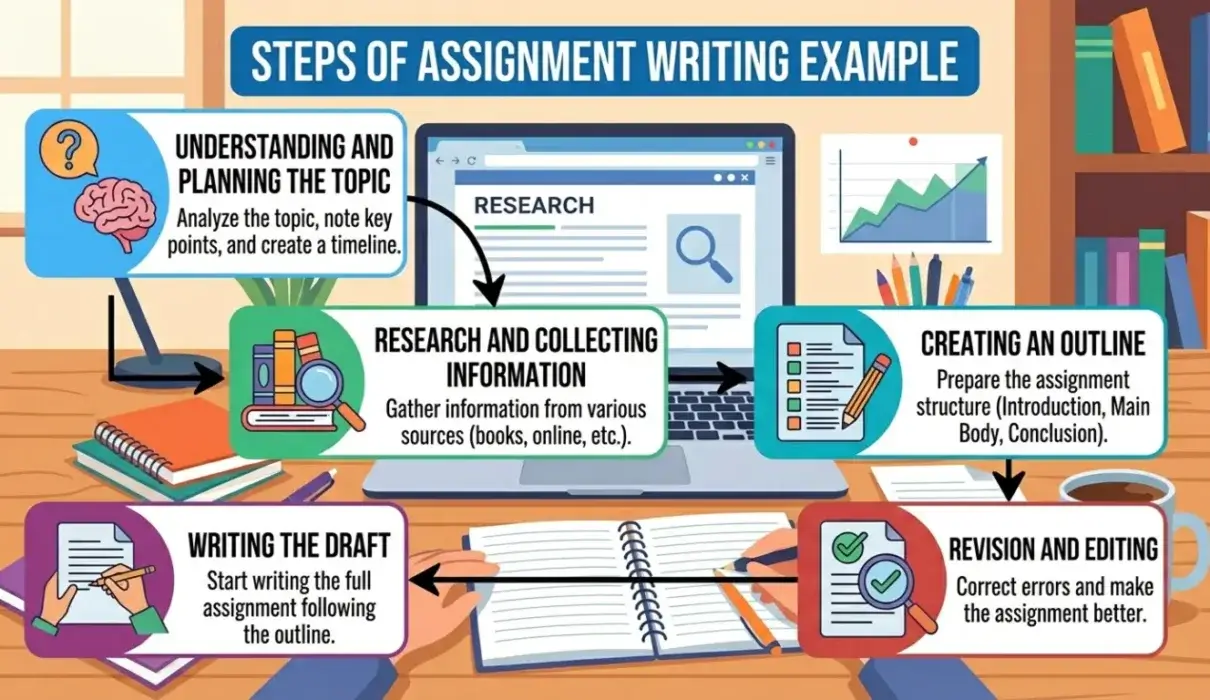
1. Prepare and Plan
Before you write your paper, you must read and re-read the question a lot of times. Then rewrite it in your own words in order to make sure you understand what is asked of you.
Also, you have to investigate and study the assessment grading criteria wisely. If you do not read it, you will lose the chance of getting the best score.
The planner needs to analyze the task. Here is how you can do it.
- Analyze the paper requirements- Grasp the prompt, clarify doubts, and set scope
- Develop an action plan and create a timetable: break down tasks into useful chunks, set deadlines, and allocate time.
2. Select a Topic
Choosing a good topic is essential, and you must select a good, relevant, and engaging topic. Do not choose a narrow or too broad topic.
Because in a narrow topic, you will find any info, and in a broad topic, there are plenty of students who have already written their papers.
In addition, if you want a written assignment example and guidance, do your research. There is tons of info available on the internet.
Here is how you can find a good topic.
- Brainstorm interest and course content
- Evaluate feasibility
- Classify research gaps
- Polish your aim
- Consult resources and take expert guidance
Main Strategies for Success
Here are the main strategies and tips to find a pertinent topic
- Remain flexible- You have to become prepared in order to adopt a good topic. All you need to do is research in-depth and find out more info.
- Check requirements- Make sure your topic fits the requirements, aims, and range. These are cases where it needs analysis, comparison, or argumentation.
3. Perform Research
Performing research is one of the main elements of writing quality papers. The more and more info you find, the more you will learn about your topic.
You have to find scholarly sources if you want to write a good assignment and get the best score. However, do not consider taking any info from blog posts or Wikipedia. These sources are not suitable for academic papers.
Top Databases for Academic Sources
Here are the top academic sources that help you find good info for assignment writing examples.
- Google Scholar: It is best for extensive searches of articles, books, and theses.
- JSTOR: JSTOR is ideal for full-text, peer reviewed academic papers, mostly in the field of humanities and social sciences.
- Research Gate: Effective for finding detailed papers and engaging with researchers.
- PubMed: The go-to source for medical or health-related assignments.
- Academia.edu: It is similar to Research Gate, normally used in the humanities. Science.gov: There are more than 50 databases for scientific information.
4. Craft an Outline
Now you have to draw and craft an outline once you perform detailed research. Outlining academic papers is vital; it is a basic step that turns tricky research into a clear, organized argument.
Moreover, once you create an outline, it will arrange your ideas logically, prevent writer’s block, and make the writing practice more efficient.
And you will make sure a strong, evidence-based flow from start to end. Hence, by writing an outline, you will decrease the need for huge revisions.
Here is the typical structure of an academic task.
- Intro- In the intro section, write a task with a clear opening, and you have to catch the readers’ attention from the start. For that use, hook, context, background info, and thesis statement.
- Body- In the body section, you will have to expand your arguments. Every sentence must begin with a topic sentence. Moreover, use the PEEL structure, use a point, add evidence, explain it, and then connect to the thesis.
- Conclusion- Finally, write a conclusion, and summarize your thesis statement. And talk about the future recommendations. And remember, do not add any new info in the conclusion.
If you are writing a paper about the life cycle of an organization, use this effective guide of the different stages of the organization lifecycle.
5. Write a First Draft
Depending on your outline, craft a first draft and write anything relevant that comes to mind. For that, you have to focus on clarity and coherence.
Also, you have to make sure every section flows from start to end. When you are writing a first draft, always aim for progress instead of perfection.
Your focus must be on finishing your task on time and delivering the right message to the audience. Once you finish it, then focus on editing.
Some essential tips for success.
- Aim for the assignment- You have to make sure every paragraph directly connects back to answering the task question.
- Take regular breaks- Well, you do not need to write the whole draft in one go. Never do that, you will stress us or be tired. Instead, take plenty of breaks, and break down your paper into smaller, handy chunks. Further, use effective time-management techniques such as the Pomodoro Technique.
- Use our own voice- You must clarify the evidence in your own words, instead of just listing down quotes and sources.
- Accept the messy dump- Finally, if you are unable to write or facing writer’s block, you will need to simply jot down your ideas without worry about formal structure. After that, you can arrange it easily.
For inspiration, a wide range of writing assignments examples are accessible on the internet about drafting a paper. Go and find it; for that, do your own research.
6. Revise and edit it
Once you have finished writing your paper and drafting it, now it is the time for you edit and revise your paper for perfection.
To edit your paper, you have to revise it at least 2 times. And investigate for the errors, typos, and awkward phrasing.
You can also read aloud your paper from start to end, and then analyze how it sounds to the readers.
To revise and proofread without worry about the whole thing, engage with a good proofreader. A skilled and experienced proofreader not only helps you proofread your work. But your paper will be free from any mistakes, and also your paper written by an expert in the field.
Here are the effective tips for revising and proofreading your paper.
1. Phase 1- Revision, the big picture
The revision strategy comprises re-seeing your paper in order to boost your content, organization, and argument.
- Take a break- For that, you have to take a break for at least 1 day to grab fresh eyes that assist you in catching inconsistencies.
- Analyze the prompt- Make sure you have directly solved and answered every part of the task prompt.
- Look at the structure- Now you have to make sure the argument flows logically. And answer the questions, such as does your intro lead to the body paragraph? And do the conclusions keep up with the evidence?
- Examine the paragraph- Every paragraph of your assignment must have one main idea. Also, you must back up your paper with evidence and a clear topic sentence.
- Improve clarity- In the final step, you have to remove redundant, wordy, or confusing sentences.
2. Phase 2 Proofreading (Surface mistakes)
Here comes the proofreading and final part; you have to make sure your paper will be free from mistakes, typos, spelling errors, and awkward phrasing.
Below are the effective proofreading techniques you need to use.
- Read aloud- One of the best proofreading techniques to proofread an assignment is reading aloud. This method helps you classify missing words, poor phrasing, and awkward sentence structure. Normally, students miss it as they do not bother to read aloud once they are done writing their papers.
- Read backward- Now, read your paper from the start to the first words; it is a reading backward technique. This strategy disrupts the familiar flow and helps you look closely at every sentence.
- Print it out- You can as well print out your paper in a physical form. This method helps you classify and spot mistakes you often miss on a laptop screen.
- Use Tools wisely- To conclude, you can also use tools such as Grammarly. However, do not depend on it.
Examples of Assignment
Here are the different examples of assignments.
1. Academic Essays
Academic essays, like argumentative or expository papers, analyze topics such as ‘’ the impact of a parent, teacher, or friend on your life’’. Or you are accessing certain literature.
2. Research Papers/ Reports
A research paper or report typically presents an in-depth analysis of a subject, such as a company stakeholder analysis. Or Marketing change plan.
3. Case studies
Case studies are detailed examinations of a specific entity. Example business, patient, in order to solve an issue or analyze a situation.
4. Annotated Bibliographies
This assignment is essentially a list of research sources, with summaries and appraisals of each source’s relevance.
5. Reflective Journals or papers
These academic assignments usually reflect on personal experience or learning outcomes.
All in All
To cut a long story short, an assignment is a valuable skill that every student needs to master. It will not only help you in your career.
But you will develop skills such as critical thinking, creativity, writing, research, and time management.
By preparing and outlining it, brainstorming ideas, research, outlining, drafting, and finally revising and proofreading, you will surely nail your paper.
Also, you will definitely stand out from other students in the class.
Frequently Asked Questions
What are the key steps in assignment writing?
The key steps in producing a quality assignment are planning and planning, choosing a topic, research, outlining, drafting, revising, and proofreading it.
How do I analyze an assignment question correctly?
In order to analyze your paper, you have to break it down into certain elements. These are task words, content keywords, and limit words.
What should a good assignment outline include?
A good academic paper comprises 3 elements: an introduction with a thesis, a body with evidence, and a clear, concise conclusion.
How do I start writing an assignment introduction?
To start the intro of your paper, you will need to catch the attention of readers. For that, begin with a hook, offer essential background info. And then write a strong thesis statement in 2 lines max.
What is the best way to structure body paragraphs?
The best method to write a good body section is using a PEEL (Main idea, evidence or quotes from sources, explanation of your interpretation, and link to the next paragraph or topic.
How can I ensure my writing is academic and formal?
You have to make sure your writing is academic and formal, with a focus on objectivity, free of personal bias, clarity, and an organized, evidence-based method.

