 By
By Plagiarism in an assignment can ruin every effort you made in your writing.
I completed my Master’s degree in Human Resources back in 2023. During that time, I was working on a change management plan as an assignment. And trust me when I say this, I actually burned the midnight oil on that assignment.
Research, writing, everything was on point. And then came that moment that made me cry for 20 minutes. Plagiarism!!!
And guess what? I was not the only one. It happened to half of my class. Yes, this happens to students more than we expect. That 20-minute crying session taught me that knowing how to check plagiarism in assignments is one of the most essential skills a student can possess. It is not complicated; it only requires active thinking anf strategies.
Whether you are studying in Dubai, Abu Dhabi, or Sharjah, academic writing is taken seriously across the UAE universities. And since I have suffered from that horrible phase, I would never want anyone else to go through it. So this guide will reflect on what plagiarism is, why it is important in academia, some effective tools to use for it, and how to keep your work original from the beginning so this nightmare of plagiarism never knocks at your door.
What is Plagiarism?
The first question that students ask is What is plagiarism in academic assignments.
As per the Oxford definition:
“Plagiarism is presenting someone else’s work or ideas with or without the consent of the original author, and using it as your own. It also includes re-using your own work without citation. Under the regulations for examinations, intentional or reckless plagiarism is a disciplinary offence.”
Plagiarism in academic assignments includes:
- Direct copying: Using textual content without giving proper credit to the original author
- Paraphrasing without credit: Rewriting the same idea from a source as your own and not giving acknowledgement.
- Self-plagiarism: Reusing your own work without permission from your instructor
- Mosaic plagiarism: Blending content taken from different sources and presenting it as your own
- Accidental plagiarism: Forgetting or incorrect citations
Why Is It Important to Check Plagiarism Before Final Submission
Running a plagiarism check on your content is never about distrust. It is always about protecting your academic work from being marked as ‘the content is nth% plagiarized; rewrite it.’
So before you submit your task, do the following:
| Risk | Consequence | How to check |
| High similarity score | Deduction in marks | Spot and fix before submission |
| Unintentional copying | Academic misconduct record | Find the missed citations |
| Improper paraphrasing | Resubmission required | Rewrite the plagiarized sections |
| Self-plagiarism | Ethics violation | Detect recycled personal content |
| Incorrect referencing | Fewer marks for referencing errors | Cross-check citation accuracy |
| Case Study: How one plagiarism check saved a final year project
A final-year business student studying at Dubai University was working on a 5,000-word dissertation. She submitted it without checking against plagiarism. Upon Turnitin check, it showed 34% similarity, above the 10% threshold. Luckily, her professor was lenient and gave her 48 hours to revise the content. Since that incident, she has always made sure to use Grammarly and Turnitin before the final submission. Her revised submission came in at 6%. “I had literally no idea how much I had accidentally paraphrased without citing”, she said. “One check changed everything.” This is why checking plagiarism before submission matters. |
How to Check Plagiarism in Assignments Effectively
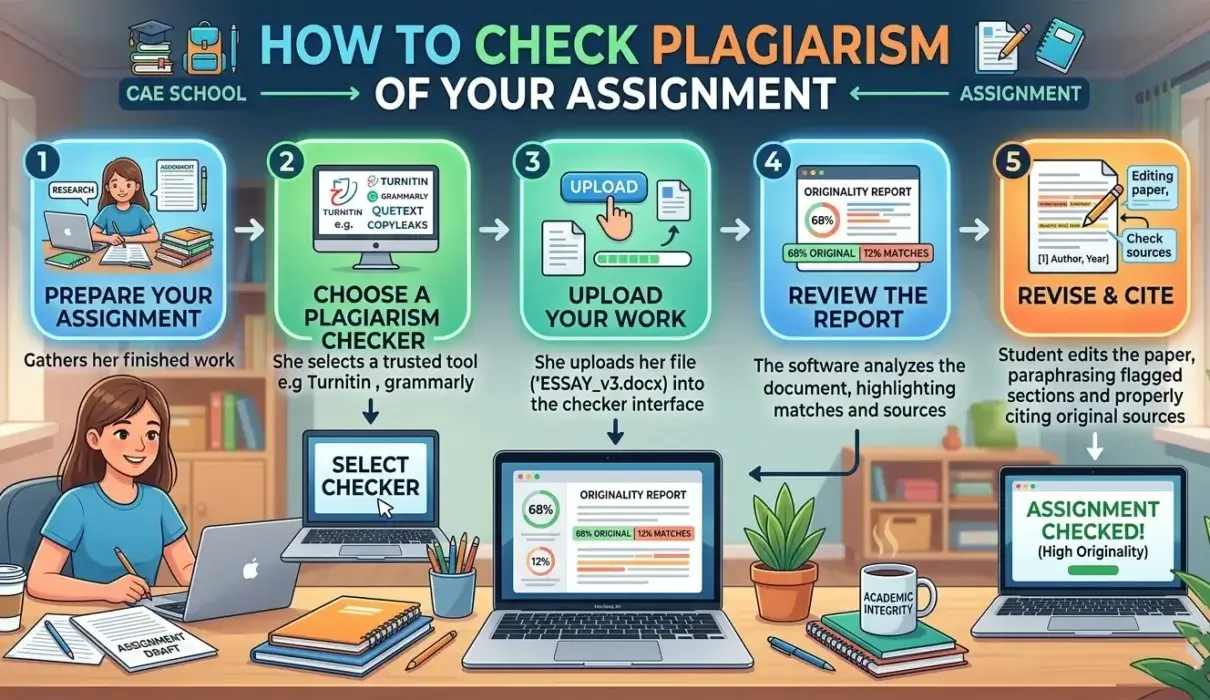
Step 1: Draft First, Then Check
Never check plagiarism while you are still writing the content. Make sure o finish the draft first because checking too early might cause anxiety and disrupt your flow.
Step 2: Use the Right Tool For Your Level
There are several free tools available to check plagiarism in assignments. However, you need to find the right one for your level. If you are submitting a CIPD or postgraduate assignment, then it is suggested to invest in a premium tool for scans. And before ensuring a plagiarism-free assignment, you must know how to write a perfect CIPD assignment to understand formatting and other official guidelines that help in securing a distinction.
Step 3: Run a Text-Matching Scan
Ensure to use academic-grade plagiarism checkers to analyse your work against billions of web pages, journals, and previously submitted student papers.
- Institutional tools: Check if your school provides free access to Turnitin or Blackboard’s SafeAssign.
- Alternate options: If you lack institutional access, it is best to use highly rated tools like Scribbr or QuillBot Plagiarism Checker.
Step 4: Know How to Read a Report
Once you have received the similarity report, you need to check the similarity score (a percentage of matching text) of your document and the colour-coded highlights.
- Filter out citations and bibliographies: Keep in mind that standard formatting and quotes will always be flagged. So ensure you adjust your tools’ settings to ignore these.
- Evaluate the remaining matches: In general, a similarity score between 10% and 15% is acceptable in academics. But it is not just about the percentage. You must manually check any highlighted chunk of text to see if you properly paraphrased or used quotation marks.
Step 5: Verify References and Paraphrasing
Plagiarism is not just word-to-word copy. It also includes improper phrasing or uncredited sources. Ensure to go through the reference list and double-check that every claim you made matches the corresponding source in your bibliography.
Best Tools to Check Assignment Plagiarism
There are dozens of tools out there to check plagiarism in assignments. But below is the clear comparison of the most popular and reliable ones for UAE students:
| Tool | Best for | Price | Database Coverage | Rating |
| Turnitin | University submissions | Institutional access | Academic journals, internet, student papers | 5/5 |
| Grammarly | Everyday writing | Free/premium | Internet and published content | 4/5 |
| Copyscape | Web content | Pay-per-search | Internet only | 3/5 |
| PlagScan | Professional / HR documents | Subscription | Internet and internal database | 4/5 |
| Quetext | Students on a budget | Free (limited) | Internet | 3/5 |
| iThenticate | Research papers | Institutional | Research databases | 5/5 |
For UAE students, Turnitin is the gold standard for checking plagiarism in assignments. Running a self-check on Turnitin’s draft submission feature is the closest thing to seeing what your marker sees.
| Worried about your assignment submission?
Our academic writing services in the UAE can help you produce original, properly cited work tailored to your course requirements. Get Expert Assignment Help! |
Common Reasons Assignment Shows Plagiarism
Understanding why plagiarism occurs is as important as knowing how to remove it. The following are the frequent causes:
- Forgetting to paraphrase: Students sometimes gather data from different sources and copy it into a document for later use. But they sometimes accidentally submit that exact content in the assignment as their own.
- Incorrect citation format: Adding citations the wrong way or citing at all – both are causes of plagiarism in an assignment.
- Over-reliance on one source: Using one textbook or online source creates a greater chance of similarity even after paraphrasing.
- Using essay mills or AI tools inappropriately: Submitting AI-generated content or bought assignments is the biggest source of plagiarism. This is completely unethical and a major academic offence.
- Quoting too much: Quotes are important in an assignment. But adding an excessive number of quotations raises your similarity score artificially.
- Self-plagiarism: Reusing your previous content without informing them is self-plagiarism.
Tips to Reduce Plagiarism in Academic Writing
Avoiding plagiarism in an assignment is essential for every grade level. But most students do not know how to do it properly.
So, below are some tips to reduce plagiarism in academic writing:
Plan Your Paper
Planning or outlining your paper is the first and foremost important step to prevent plagiarism in your assignment. Students who plan to use other sources in their work must plan how they are going to incorporate that information into their work. Make sure that you write your notes as summaries, and not copy-paste the content.
Use the Paraphrasing Method Correctly
The literal meaning of paraphrasing is to rewrite an author’s ideas into your own words. I have seen many students using the wrong approach. They read the content from a source and write it as it is or too soon without understanding it in their mind. That is wrong.
The right way of paraphrasing is that you read a passage, close that source, understand the material, and then write it in your own words. This is different from replacing a few words. It is a full rewrite of the idea.
Master the Referencing Style
Mastering referencing comes down to understanding this one core rule: every in-text citation must have a matching full reference at the end of your assignment.
Make sure to know the required referencing style because every discipline follows a different one, such as APA, MLA, Harvard, Chicago, and others. Also, if you are working on a structured HR or business assignment, then it is suggested to review the best format for CIPD assignments that will help you structure cited content correctly from the beginning.
Create a Flawless Reference List
Your reference list or bibliography provides the full publication details. Ensure that the final list is alphabetical by the primary author’s last name. Also, full references vary completely based on the type of media (book vs. journal vs. website). So always pay attention to italics, capitalization, and punctuation.
Leverage Reference Management Tools
Do not format your citations manually if you can avoid it. The best approach is to use reliable reference management tools like Mendeley, Zotero, and others. These tools automatically format in-text citations and generate bibliography.
Check Earlier in the Writing Process
It is not suggested to check plagiarism in assignments while writing. However, do not wait till the last day to check it. Because if your content gets marked as plagiarized more than 10%, then it would take a significant amount of time to fix that.
How to Maintain Originality in Your Assignment
Originality in an assignment does not mean every idea has to be brand new. It means presenting ideas in your own voice and supporting them with proper evidence.
Here is how:
| Strategy | What it involves | Benefit |
| Develop your own argument | Take a clear position on the topic | Your voice comes through |
| Use multiple sources | Synthesize 5-10 varied references | Reduces dependence on one text |
| Add your analysis | Discuss what the sources tell, and what your opinions are on it | Shows critical thinking |
| Use real-life examples | Include case studies | Adds a unique perspective |
| Review before submitting | Read aloud to catch generic phrasing | Natural voice in the content |
Mistakes Students Make While Checking Plagiarism
Students often make critical errors while checking plagiarism in assignments. In addition, these mistakes can lead to academic penalties if they are not addressed before the final submission of the task.
The following are the most common mistakes students make while checking plagiarism:
- Over-reliance on free/basic checkers: Free plagiarism checkers often have limited databases and may lack the academic depth required to catch university-level plagiarism. Therefore, it is essential to use institution-approved tools like Turnitin or Grammarly to ensure a comprehensive scan.
- Misinterpreting similarity scores: A similarity score does not equate to an automatic plagiarism violation. These scores often highlight properly cited quotes, bibliographies, or common terminologies.
- Ignoring formatting discrepancies: Copying and pasting text often brings hidden formatting codes or hyperlinks with it. Therefore, it is important to always strip formatting and review your text in plain words.
- Spinning instead of paraphrasing: There is a massive difference between spinning and paraphrasing. Only swapping out a few words with the help of a thesaurus while keeping the original sentence structure is still classified as plagiarism.
- Formatting the reference list: Bibliography matches are often ignored by professors. However, having an unformatted or poorly cited reference list can artificially bloat a similarity score.
- Using AI without verification: Students often rely entirely on AI to generate or rewrite content. This results in hallucinated facts or unoriginal phrasing flagged by AI detectors.
Benefits of Submitting a Plagiarism-Free Assignment
We all know that plagiarism in an assignment can result in rewriting, failing, or even expulsion from the course. So yes, preventing it benefits and saves you from this. But it also has long-term benefits for you as a learner. These are:
- Original work reflects critical thinking and the writer’s own perspective.
- Instructors value authentic thoughts, which eventually lead to high grades.
- Submitting original content helps to prevent the risk of academic probation because universities use high-end tools like Turnitin or Grammarly.
- Dealing with academic misconduct hearings, rewriters, and the stress of detection takes far more time than simply ensuring your work is original. It helps you save time and reduces stress.
- The idea of submitting original content helps in improving research and synthesizing information in your own words. It helps you grasp intricate course content more effectively.
- Last but not least, honesty and academic integrity are heavily valued in academia.
Final Thoughts on Assignment Plagiarism Checking
If there is one habit that every UAE student must have is to check plagiarism in assignment drafts before the final submission.
Students remember, plagiarism is not always a moral failure. Sometimes it is a skill gap, such as not knowing how to cite, a lack of understanding in adding in-text citations, swapping words instead of paraphrasing, and beyond, which leads to detecting plagiarism.
The good news is that this gap can be closed with the right tools, a bit of practice, and the habit of checking early and often.
So make sure to know the common mistakes students make while checking plagiarism. So you ensure not to fall into the same trap. Furthermore, ensure to follow the tips given in this blog and get professional help when required.
Best of luck!
FAQs
| What percentage of plagiarism is allowed in UAE universities?
There is no single universally allowed percentage of plagiarism in the UAE universities. Instead, institutions use software like Turnitin to measure the similarity score. Most universities generally expect a similarity score of 10% to 20% or less. Anything over 15-20% is often marked as an academic penalty. |
| Can I use free plagiarism checkers for my university assignment?
Yes, you can use free plagiarism checkers. But you should use them with caution. Most free tools are excellent for quick grammar and citation reviews, but they often lack access to comprehensive academic databases and can put your intellectual property at risk. |
| Is paraphrasing enough to avoid plagiarism in an assignment?
No. Paraphrasing alone is not enough to avoid plagiarism. While putting information into your own words shows that you can understand the material, the idea belongs to the original author. You need to do two things every time you use an outside source to completely avoid plagiarism:
|
| Does the reference list count towards the plagiarism score?
Yes, your reference list is technically counted by plagiarism checkers. This artificially inflates the overall similarity score. But this is perfectly normal and expected in academic writing. |
| What should I do if my plagiarism score is too high?
If your plagiarism or similarity score is too high, do not panic or resubmit the assignment yet. First, check the highlighted marches to see exactly where the software flagged. Then exclude quotes or bibliography page as software often erroneously flags these. It is essential to rephrase heavily flagged paragraphs into your own words and ensure you have proper in-text citations for all direct quotes. |
| How many times should I run a plagiarism check on my assignment before the final submission?
You should run a plagiarism check once or twice. The most critical check should be done at the end when once you have completed all the edits and formatting is also finalized. |

